01
Problem
AI assistance becomes risky when model output can directly trigger operational actions without clear boundaries, validation or accountability.
 Bakr MostafaOPERATIONS · SOFTWARE · AILinkedIn ↗
A private orchestration pattern connecting language-model reasoning to policy-controlled tools, workflows and auditable execution.
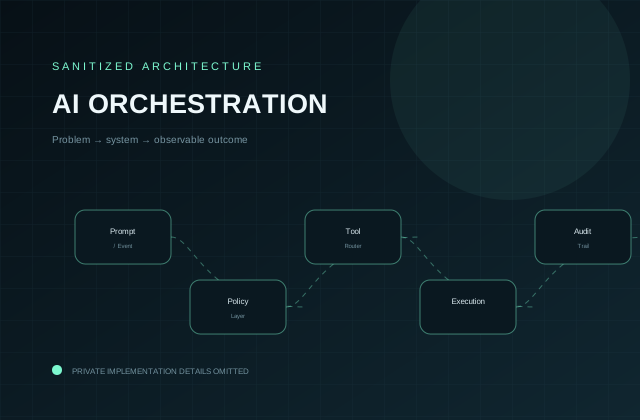
The diagram supports the explanation below. Important information is kept in readable HTML rather than embedded as tiny image text.
AI assistance becomes risky when model output can directly trigger operational actions without clear boundaries, validation or accountability.
Enterprise actions need permissions, traceability, deterministic controls, failure containment and the ability to evolve model providers without rebuilding the operating layer.
Separated reasoning from execution. AI proposes structured intent; policy and deterministic services validate, route and execute bounded actions through explicit interfaces. Audit events capture what happened without exposing secrets.
User / event
  ↓
AI reasoning
  ↓ structured intent
Policy + validation
  ↓
Tool / workflow router
  ↓
Deterministic execution
  ↓
Audit + observable outcome
Created a reusable architecture for AI-assisted operations where the model is a reasoning component rather than an uncontrolled executor.
Credentials, private infrastructure, proprietary mechanisms, internal prompts, customer-identifying data and implementation recipes are intentionally excluded. Architecture decisions, trade-offs and delivery reasoning can be discussed in an interview.
← Back to mission deck